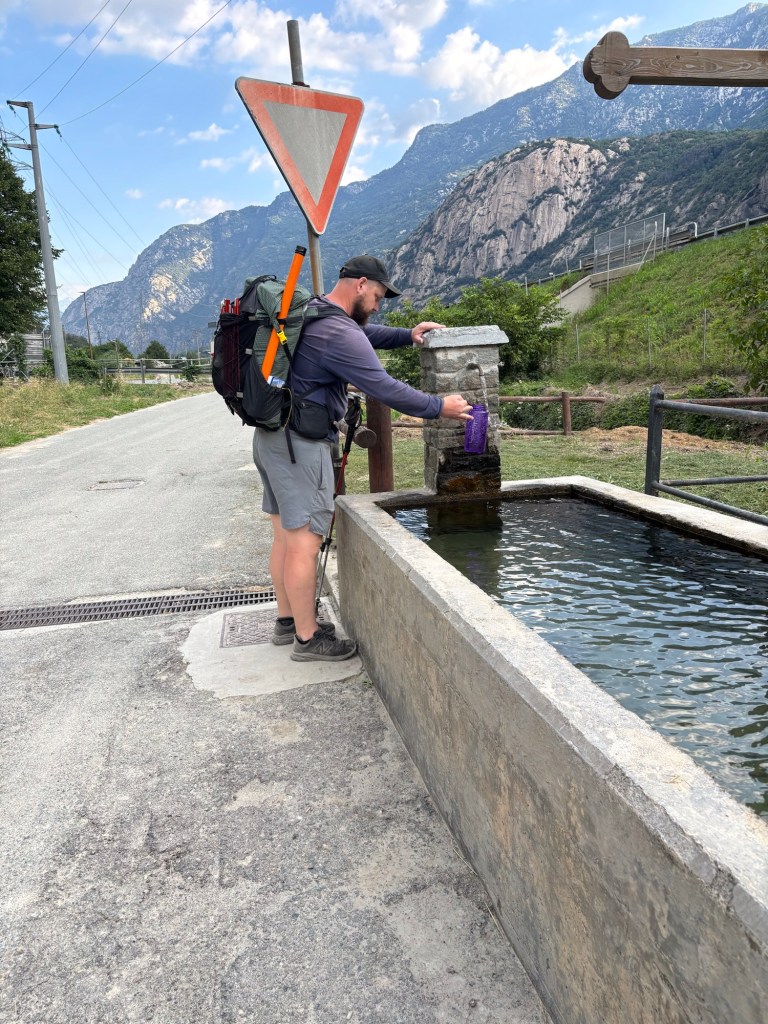
Today began at 6:45 a.m. with a ramble up the hill headed east behind our hotel. This has become a morning ritual here in the Aosta Valley as most of the towns so far are positioned on the east side of the Dora Baltea River that runs through it. The Via Francigena winds along the eastern slopes of the Aosta Valley.




Experience
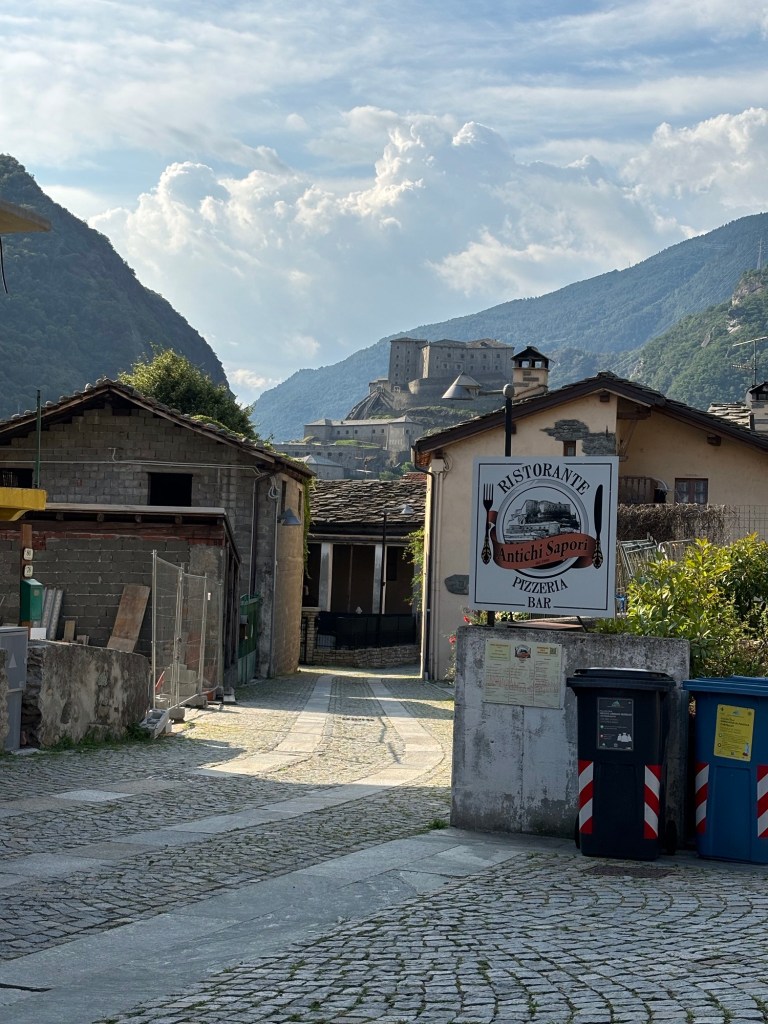
About 3 hours into our hike this morning we enter the town of Hone (population 1,142) and grab a bite to eat. As we enter the town center and begin to set our eyes on the Bard Fortress and Borgo Di Bard village (population 117), we begin to walk along the beautiful Fiume Ayasse running through this delightful town. This is the first legitimate waterway we’ve encountered that did look like a Chik-fil-A milkshake.

Gabe’s eyes light up at the sight of this river. He is excited. In another episode of Trail Magic, an elderly couple in their mid/late 80s approaches me as we exchange greetings and the uomo anziano [old man] begins to speak to me very enthusiastically in Italian asking me where we’re headed with these large packs on our backs. I quickly exhaust my Italian as I explain that, ideally, I would find myself somewhere in Tuscany in a month’s time. Unusually absent from this initial exchange is Gabe who eagerly engages these opportunities to practice his Italian phrases. When Gabe approaches the conversation, he leads very seriously with the face of his phone showing this couple something that throws them into near hysteria as the uomo [man] becomes even more enthusiastic and his molglie [wife] begins hurriedly rummaging through the pouch on her walker and pulls out her phone. The picture on Gabe’s phone is a translation of: “Are there any fish in the water here?” The picture on the vecchia donna [old woman’s phone] is a picture of four beautiful trout recently caught by the couple in this river and I witness a trout lover’s jamboree before my very eyes. The three people I’m with find connection over the splendor of fish and my buddy Gabe is over the moon. We have found the town fisherman (& woman apparently) we’ve been searching for since landing in Milan. Gabe drops his pack and fishes out (pun intended) his box of flies and pops the orange tube containing his rod, showing our new friends his gear and asking for advice with fly selection for this river, etc. Game on! I’m now attending a fishing party on a bridge in the center of Hone. All good things must come to an end … we exchange handshakes and smiles and holy fishing prayers and the couple continues their walk to town along the river.

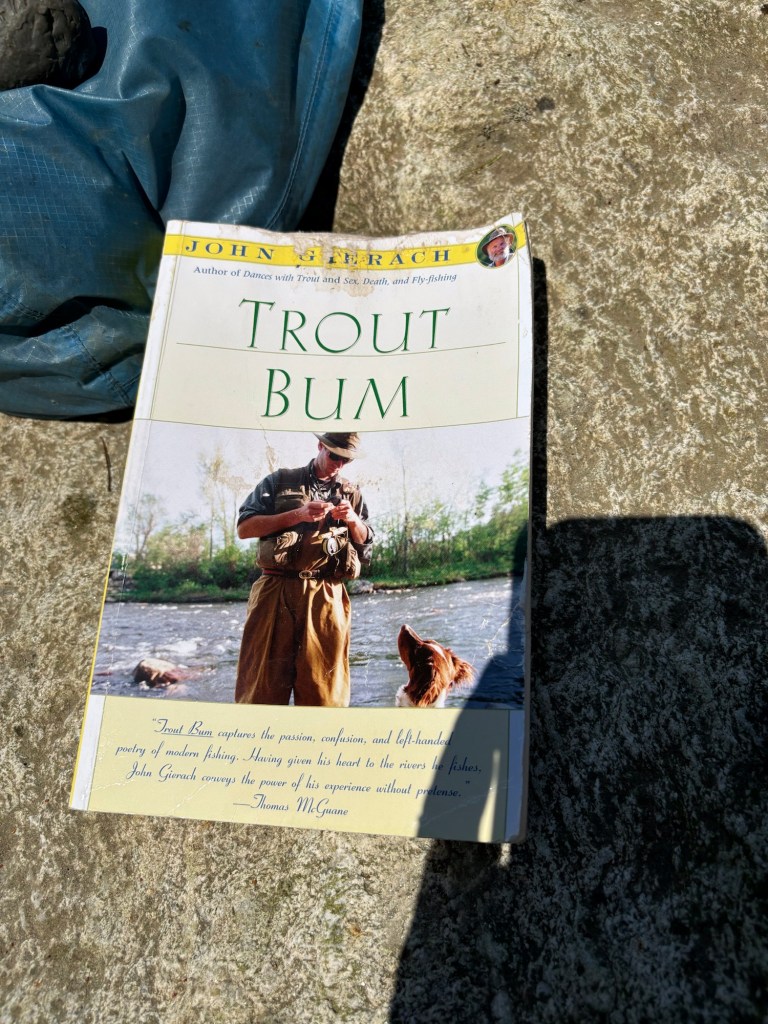
To say that Gabe is obsessed with fishing is probably an understatement (can I get a hearty “Amen!” Ginny?). Among many other deeply thoughtful musings about our world, our faith, our responsibility as humans, economics, politics, etc., his bottom line is often “Is that fishable?” or “When can I get a line back in the water?” In addition to his fishing gear, the guy also lugged a physical book about trout fishing to Italy. To put that in perspective, the majority of our coordination for this trip was how ultralight can we go with our gear (targeting < 15% of our body weight) … and Gabe brings gear and a fishing book. He’s dreamt of wetting a line in Italy. He dreams of moving to Montana one day … to fish. He pretends to catch trout to amuse his daughters. And, he’s evaluated every waterway we’ve encountered for fishing possibilities and questioned whether every nearby town we’ve entered might contain a sporting goods store or tackle shop with a real fisherman (or woman) with whom he could engage for one of life’s most important questions: “Are there any fish in the water here?” Makes me wonder how long that question had been sitting in Gabe’s translation app. Do translation apps feature saved questions? Maybe Gabe has a trout specific translation app? Not kidding …
Today, I witnessed a bit of trail magic in the serendipitous encounter with an elderly couple and witnessed a man realize a dream. It honestly brought tears to my eyes.


History
Borgo di Bard Fortress
In the early 6th c., Roman soldiers were garrisoned at Bard and from at least 1034 a medieval castle stood at this site, a key choke point in the lower Aosta Valley. In 1242 the Savoys controlled Bard and used the fortress to levy tolls on travelers. In May 1800, it took Napoleon’s 40,000 soldiers over two weeks to dislodge the 400 Austrian soldiers defending it. After capturing the fortress, he dismantled it to protect his rear flank and supply lines. Beginning in 1830, the fortress was rebuilt, though it began to deteriorate later in that century and ultimately was used as a prison, a military depot, and now as a museum and exhibition center


Emma Gatewood
In terms of long-hike history makers, one of the more unlikely legends in the long-hike trekking world is Grandma Emma Gatewood. Some have credited her with saving the Appalachian Trail, but most everyone who has read or heard her story are left with the realization that she was a remarkable woman ahead of her times in many ways. To a lesser extent than Gabe consumes trout fishing books, I consume (term probably overstates the voracity of my reading … words or statements like “occasionally” or “when I get the chance” are more accurate) hiking books about long-hike and climbing adventures. One of the more recent books on the topic I read (at the recommendation of my mom), was Grandma Gatewood’s Walk, by Ben Montgomery.
The following paragraphs are from the book’s summary on Amazon:
Emma Gatewood told her family she was going on a walk and left her small Ohio hometown with a change of clothes and less than two hundred dollars. The next anybody heard from her, this genteel, farm-reared, sixty-seven-year-old great-grandmother had walked 800 miles along the 2,050-mile Appalachian Trail. By September 1955 she stood atop Maine’s Mount Katahdin, sang “America, the Beautiful,” and proclaimed, “I said I’ll do it, and I’ve done it.”
Driven by a painful marriage, Grandma Gatewood not only hiked the trail alone, she was the first person—man or woman—to walk it twice and three times. At age seventy-one, she hiked the 2,000-mile Oregon Trail. Gatewood became a hiking celebrity, and appeared on TV with Groucho Marx and Art Linkletter. The public attention she brought to the trail was unprecedented. Her vocal criticism of the lousy, difficult stretches led to bolstered maintenance, and very likely saved the trail from extinction.
Author Ben Montgomery interviewed surviving family members and hikers Gatewood met along the trail, unearthed historic newspaper and magazine articles, and was given full access to Gatewood’s own diaries, trail journals, and correspondence. Grandma Gatewood’s Walk shines a fresh light on one of America’s most celebrated hikers.
From the first paragraph of her Wikipedia site:
Emma Rowena Gatewood (October 25, 1887 – June 4, 1973), better known as Grandma Gatewood, was an American ultra-light hiking pioneer. After a difficult life as a farm wife, mother of eleven children, and survivor of domestic violence, she became famous as the first solo female thru-hiker of the 2,168-mile (3,489 km) Appalachian Trail (A.T.) in 1955 at the age of 67. She subsequently became the first person (male or female) to hike the A.T. three times, after completing a second thru-hike two years later, followed by a section-hike in 1964. In the meantime, she hiked 2,000 miles (3,200 km) of the Oregon Trailin 1959. In her later years, she continued to travel and hike, and worked on a section of what would become the Buckeye Trail. The media coverage surrounding her feats was credited for generating interest in maintaining the A.T. and in hiking generally.

Why do I bring her up you ask? When Gabe and I left Arnad this morning, no more than a hour outside of town, I spotted an unusual sight – a female hiker in her late 60’s coming up a paved road behind us with a large pack and a bucket hat. I made a brief comment to Gabe that I’d spotted Emma Gatewood. As we continued to walk, I looked back several times wondering if she would catch-up to us as our friends Pascal and Speedy had the previous day. She did not. In fact, I didn’t see her again despite our stopping several times, including a brief breakfast. Then, nearly 2 hours after my first spotting her outside Arnad, Emma emerges on the tail-end of our trail magic fishing encounter with the elderly couple of Hone, takes a left as she approaches us on the bridge and follows the elderly couple into town without not so much as a “buongorno!” and dissappears again … a very unusual move (maybe even taboo) not to engage with follow pilgrim. Unless she bunked with Pascal and Speedy of Andrea last night and knows all she cares to know already … obnoxious Americans. Anyway, I’m now obsessed with finding my own version of Gabe’s trout: Where is Emma?

We finished our day in the town of Quincinetto in a large camping ground next to, you guessed it, a potential trout stream.
Today, we passed from the Aosta Valley into the Piemonte region of Italy. Piemonte is world renowned for its wines. Some of the best in the world … Barbaresco, Nebbiolo, Barbera, Borolo wines are all grown and produced in this region of Italy.




 Wander With Me
Leave a comment